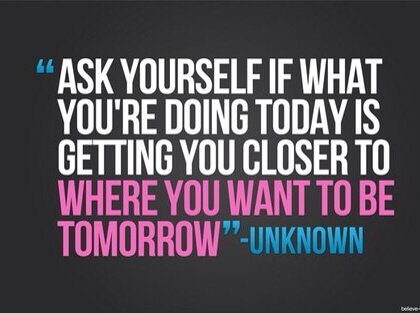
The Approach to Setting Goals

Most individuals are aware of and know that settings goals can be an important benchmark to chart our progress. Setting goals is an important directive to help us all achieve bigger and better things in our lives. However, many of our students voice these questions: “How do we set goals? How do we prioritize goals? Where do I start? What goals are important and which goals are not really goals?”  These are all great questions! Don’t procrastinate… lets get to it!
procrastinate_goals

What we do when setting goals is important in and of itself. If we set goals that are too generalized, a lot of our direction can get lost in the ambiguity of the goal itself. In other words, lets say that the goal is to become more physically fit. What would work better, saying, “I have a goal to get more physically fit.” or, “I have a goal to jog for 30 minutes, 3 times a week and swim laps in a pool for 30 minutes twice a week.”? Of course the latter sounds better! It is more focused, descriptive and detailed. One of the tools we suggest for our students to use is what we call the O.S.T. model. The OST acronym stands for Objective – Strategy – Tactic. It helps us to identify goals in a broader sense and narrow down our approach to accomplish that goal. Lets walk through what that would look like:

Objective:

Get more physically fit.

Strategy:

Lift weights and participate in aerobic activity.

Tactic:

Lift weights in the gym on Monday, Wednesday and Friday morning. Go to a cycling class on Tuesday and Thursday evening after work.

Great! So we’re done, right? Not quite. Although the OST model is helpful and a good line to follow, we need to make sure that our other life goals are in sync with our goal of getting physically fit. If getting fit was my personal goal but my eating behavior was out of control, working out 5 days a week would only get me so far. But if I set OST goals for eating, sleeping, socializing, etc… My goals would start to compliment one another and help to keep me on track! In short, when goals are not focused and detailed, they typically do not happen.

This is yet another tool you can add to your tool belt when communicating and helping to empower your failure to launch or boomerang son to make healthy, specific goals that are measurable and attainable!

Best wishes,

Forte Strong


About the Author

Matthew Arrington grew up in Southern California and has a deep fondness for the ocean and water in general. He’s lived in most of the western united states and attended school in Oregon, where he earned a few degrees in business including, marketing, leadership and organizational management and a Masters in Business. Matt has a huge passion for working with young men to increase their chances of success and credits his current success to the many positive male role models that helped him grow into manhood.

Can the Dog Whisperer Stop my Son’s Negative Behavior? Part 4

LEADERSHIP…

Why it’s so important.

In my last post I talked about LOVE. This week I’m going to focus on the 4th fundamental in changing your son’s negative behavior: LEADERSHIP. Leadership is the last and most essential part of curbing your son’s bad behavior. Why? Because, just like dogs, people follow leaders.

The most important thing that we have to provide every day is that we are the pack leader, that we set the rules, the boundaries and the limitations, and then we love. Most people get a dog because they need somebody to love. So they are going after what they need, not what the dog needs. And that creates instability immediately and the dog sees the human as a soft energy. Dogs don’t follow the lovable leader or the spiritual leader; they follow the dominant one. -Cesar Milan

Of all the fundamentals, leadership has the tendency to be the most elusive and often difficult to put into action as a result of it’s perceived complexity. This is why leadership means so many different things to so many different people. But how does LEADERSHIP apply to parenting, specifically in relation to failure to launch syndrome or what’s being called the Peter Pan Syndrome? Let’s begin by covering a few things about leadership you may already know.

What You Already Know

We all know leadership is about doing the right thing for the right reasons even when it’s painful, scratch that… especially when it’s painful. Yet, human beings have a difficult time with pain and parents are no different. Parents who have a son or daughter who is struggling with failure to launch syndrome understand the gravity of the situation. They understand what’s at stake and they know all too well that their child’s future hinges on his or her ability to problem solve, push through obstacles and remain resilient in the face of life’s challenges. No matter how brilliant or talented your child may be, when the storms of life come and your child begins to falter, parents can lose sight of what’s most important. Some parents are instinctively aware that their son or daughter does not have the skills required to be successful without instruction and guidance and look to Forte Strong for help. Unfortunately, some parents find it too painful to watch their son wade through the hardship and adversity and as a result, step in at a crucial moment in their child’s transition to adulthood. Unfortunately, this type of rescuing only creates entitled, scared, unconfident and depressed children who are easily frustrated, easily broken, easily manipulated and easily distracted, most notably by drugs, sex or toys which includes gaming.

My heart really goes out to these parents. Why? Because these aren’t bad or incompetent parents, on the contrary, these parents are bright, educated and devoted mothers and fathers who want what is best for their children, but at some point they let worry and fear slowly control their actions. Before long these once capable parents become overly-protective and have a difficult time letting go, taking a step back and letting their child take on challenging tasks on their own without jumping in, rescuing and micromanaging their life. When you think of leadership… do you think of a hovering, rescuing and micromanaging parent? Of course not. So What’s the answer? What is a parent to do when there is so much going on and so much at stake? When there are so much to consider and so many variables? I can tell you from experience that overwhelming yourself with a ton of complicated or confusing opinions and filling your brain with more and more information is not always the answer. It would be wise to stop, take a step back and look at the bigger picture.

In cases such as this, less is indeed more. The truth is, “you already know the answer.” The parents I talk to on a daily basis aren’t asking me for advice, though it might seem that way, they are asking for reassurance… there’s a big difference. A parent who needs advice is saying, “I don’t know what to do, please help.” A parent who needs reassurance is saying, “I know what I should do, I’m just scared.”  For most parents, I say go with your natural instinct… go with your gut. Where parents usually go wrong is when they don’t stick to their gut long enough. It takes time, patience and an unwavering commitment to see things through… this is where LEADERSHIP is everything.

leadership_sign

WHAT LEADERSHIP REALLY IS.

Leadership in it’s purest form is the power to INFLUENCE others… period. Leaders have a unique ability to influence how others think, how they feel and how they act. Let me ask you a question… if you were to rate how much influence you have over your child on a 1 to 5 scale, 1 being no influence and 5 is a lot of influence, what would it be? Most parents I talk to tell me 1, sometimes ZERO!! Why such a low score? Why do some parents have little to no influence with their children when many of these parents are successful doctors, lawyers, business owners, and teachers, yet they come to me frustrated, bewildered and downtrodden, wondering why they have no influence over their children.

If there’s no influence in the home and leadership = influence, then we can surmise that there is a lack of leadership in the home. Tough to swallow, I know, but don’t throw in the towel just yet, it gets better. I’ve been able to help parents just like you change their situation and turn things around quickly. In the end, leadership is the answer. The good news is that leadership is a skill and a skill can be learned and honed. So, if you want to start having some influence over your kids, keep reading.


WHAT LEADERSHIP ISN’T.

Instead of covering what steps you can take to become a good leader, I thought it might be easier if I explained the steps that make a bad leader. Strange approach I know, but sometimes the best way to discover what works is by first understanding what doesn’t work. With that said, let me introduce you to the 5 Steps leaders should avoid at all costs… parents included.


strive for excellence not perfectionStep 1. Don’t be the perfectionist nor the victim

There are those who can’t admit they made a mistake and those who can’t stop admitting they made one. Neither approach creates influence. How you handle your mistakes is so important. Lean too far to one side or the other and you’ll quickly regret it. Most of us are painfully aware of our mistakes, parents included, yet too many try to hide them. Parents who can’t admit they’ve made a mistake give up their power while parents who admit to every single mistake do the same. Have you ever spent time around someone who thought they were perfect or went on and on about how they weren’t? Not fun. Leaders admit mistakes when it’s necessary… they don’t hide them nor do they showcase them.

Tip: Parents can use mistakes to their advantage by using them as an opportunity to teach their child a valuable lesson: how mature adults properly address mistakes. Leadership isn’t about avoiding mistakes, it’s about how we handle, react and respond to them when we do.

Step 2. Don’t let stress lead you to control others.

Parents can get desperate when the influence they once had with their children begins to wane or disappear. As a result, parents can resort to managing their son or daughter’s stuff as a form of influence or control, taking away their Xbox, Playstation, Wii, laptop, car, phone, TV or anything else that might give them some control over what seems a hopeless situation. What you need to know is that managing your child’s stuff doesn’t work; this approach only creates resistant, resentful or highly adaptable (not in a good way) children and that’s not the goal. The opposite end of the spectrum exists as well. When taking things away doesn’t work parents can resort to giving their children everything they want instead. I think you know the answer to this approach as well… giving your children everything as though they’re the center of your universe doesn’t work either. You need to find another way to influence your children without always turning to the carrot or the stick. If you want to gain influence, gain their trust first. You can do that by avoiding #3 on my list.


what we permit we promoteStep 3. Don’t end up negotiating. Stand your ground.

Ever been around someone who doesn’t follow through on what they said they would? Who makes promises they can’t keep… perhaps daily? Someone who says they’ll clean their room, do the dishes or promises to get a job but does not? Someone who cleverly disguises problems as something that exists outside their control? Who blames the weather, the economy, the government or possibly you for their unfortunate situation? Do you know someone like this personally? I’m assuming, yes. Question is, do you draw the line and hold him accountable or do you negotiate by giving him extra time… after all, one more day won’t hurt, right? But that day soon turns into weeks and those weeks turn into months and so on and so on. What’s lacking is leadership. Leaders hold others accountable for their actions or lack thereof. Leaders don’t bend the rules to suit themselves nor anyone else for that matter. They don’t negotiate every time someone has a problem or an issue about the house rules or the family structure. Leaders don’t concede or surrender to avoid conflict. They hold firm to their values and their principles such as honesty, trust, accountability, kindness, patience, respect and hardwork to name a few.

If you give only 80 percent leadership, your dog will give you 80 percent following. And the other 20 percent of the time he will run the show. If you give your dog any opportunity for him to lead you, he will take it.” – Cesar Milan

Step 4. Don’t kid yourself. Pretending things are OK doesn’t make them OK.

After years and years working with parents personally on a daily basis, I’ve come to learn one simple truth… parents have a limited amount of time, a limited amount of energy and as a result they often have a limited capacity to solve their child’s problems. Yet parents still continue to worry themselves to death with the limited amount of time, energy and capacity they do have by either overcomplicating the issue or even worse, ignoring it altogether. It’s no mystery as to why so many parents choose to turn a blind eye and go about their merry way… at least for a time. It’s the same reason why many of us don’t go to the dentist with a toothache until the pain is so unbearable that we have to. Why wait for the inevitable? Accept the situation for what it really is and then move to Step 5… look to the future.


leadership_visionStep 5. Don’t make choices for today, make choices for tomorrow.

Vision is one of the most important parts of being a leader. Vision means being able to see into the future. Being able to clearly understand what choices you can make today that will create a better future for you tomorrow, regardless of the hardship, discomfort or pain involved. Parents sometimes make choices based on how they feel at the moment, but is that the right choice for your family’s future? Leaders understand the inherent benefits that come from adversity and hardship. They understand that a bright future might mean a dark present… but only for a time. Ask yourself: Do you understand the costs and rewards attached to your present course?


Let me summarize. YES… you can do this Mom and Dad! The question isn’t about HOW you are going to do it, it’s WHEN you are going to do it. Let me ask you a question. “What’s your gut telling you right now?!” No, that’s not your stomach screaming for a Cheeseburger or a Starbucks frappuccino. That’s your GUT telling you something important. What’s it telling you? It might be time to STOP, take a STEP BACK and LOOK at the BIGGER picture. My advice… Go with your GUT.


About The Author

Brook Price dedicated himself to helping others early in his life. He grew up in Sunny Orange County California, then joined the Marine Corps at the age of 21 serving five and half years as a helicopter crew chief and then as chief accountant. His journey with this type of work began when he volunteered as a Young Marines Instructor during his time in the Marines, helping kids get off the street, improve their lives and develop as a leader. After his tour Brook left the Marines to pursue a career in experiential therapy by attending Southern Utah University where he majored in outdoor recreation with a minor in psychology.

Brook has seventeen years of experience working for a variety of different therapeutic and transitional programs across the nation. His thirst for knowledge drove him to learn and study successful therapeutic models and programs across the country, most notably Outward Bound. Brook has experience working with therapeutic, residential, military, wilderness and transitional programs for both adults and adolescents.

Want to read more articles by this author? You can also find Brook Price on

SaveSaveSaveSave

Can the Dog Whisperer stop my son’s negative behavior? Part 1

Cesar Milan or the ‘Dog Whisperer’ has a knack for taking the very worst dogs and turning them into great dogs in a matter of minutes. But what is it about the ‘Dog Whisperer’ that makes him so special? How can one person experience so much success with such ruthless and vicious animals when others consider them unteachable, unreachable and unchangeable? More importantly, can those same techniques be used to put a stop to your son’s negative behavior? Join me as we probe this question and explore the fascinating world of ‘dog psychology.’

 WHY CESAR’S TECHNIQUES WORK.

Is it really  possible to take the very worst behaviors and turn them into great behaviors in a matter of minutes?  With dogs, yes. However, its a bit more complicated when it comes to human behavior, but not as much as you might think. In fact, there’s a lot Cesar Milan and his dogs can teach us. Cesar Milan is an expert in canine psychology with years and years of experience but Cesar himself is not the miracle, the miracle is in what he teaches. Cesar’s techniques work for 3 simple reasons: they make sense, they’re easy to understand and even easier to implement. It’s not difficult to uncover the secret behind Cesar’s secret formula because he has no secrets. Cesar shares his knowledge freely to anyone willing to listen, much like a Sunday preacher relentlessly repeating the same sermon, giving the same instruction, never deviating from the same fundamental lesson. Cesar’s focus has always been on the fundamentals and that is why they work and that is also why he has experienced so much success. The good news is, you can experience some of the same success, with a little practice.

dog_whispererNow I don’t want you to think I started watching the “dog whisperer” with the sole purpose of helping parents help their son behave better; I started watching it for the same reason most people watch it, I’m a dog lover. Yet, I was a sceptic. Considering the many unfortunate encounters I’ve experienced with vicious dogs throughout my childhood, I was sure the show was a fake, yet another part of me whispered, “What if this guy is for real? What if he really can rehabilitate these dogs into lovable companions in a manner of minutes?” Well, I had to find out for myself and with one episode I was hooked. Why? Because Cesar deals with real life issues! No gimmicks, no acting, no lines, no fabricated plots, just real people with real problems being taught simple techniques that not only worked, but were super easy! It was about the 10th episode when I realized Cesar was teaching his clients exactly what I was teaching my parents, only Cesar’s version was simpler, stripped down to its purest form and it was then that I began to make a connection… why should I not do the same thing… take a process as overly complicated and confusing as rehabilitating young men and making it even simpler, easier to understand and even easier to implement for parents who knew nothing about Forte Strong and our curriculum. That was when I decided… it was time to go back to the fundamentals.


FUNDAMENTALS ARE THE KEY

There are 4 basic fundamentals that I teach on a daily basis, very similar to Cesar’s approach, that will help put a stop to your son’s bad behavior. Remember,  focusing on the fundamentals is the key! Think about it, those who are the best at what they do focus on the fundamentals…  the top businesses do it, the top teachers do it, the top athletes do it, the top coaches do it, then why don’t we all do it? Well, because its hard. Because it takes discipline and consistency. Let’s face it, we’re human and as humans we want things to be easy and not only do we want it to be easy, but we want it to be new and different and shiny and cool. It’s human nature to be constantly looking for new ways to get things done easier, faster and cheaper but unfortunately that doesn’t always mean better. So ask yourselves, when it comes to dogs what is the easiest and fastest way to control a dog’s behavior? You could buy a video surveillance system to keep track of him when you’re away from home. You could give him special toys or gadgets to keep his mind constantly occupied so he doesn’t chew up the couch. You could even give him some special pills to help him be less anxious or depressed (yes, they make pills for dogs too). But do these gadgets and pills really solve your dog problems? The answer is no and the same can be said when it comes to your son; gadgets and pills and money and material things don’t solve the behavior problems and they never will. Yes, they may help a little but they don’t solve the real issue because these type of solutions are a quick fix solution rather than the long-term solution. Parents, especially those with busy and hectic schedules often rely on quick-fix solutions to solve long-term problems instead of long-term solutions for long-term problems. So, before we begin to look toward new drugs and new gadgets and new toys, we must first realize that bad behavior isn’t new… and neither are the techniques that can put a stop to it. Cesar doesn’t use the latest gadgets or special treats to get his dogs to change their behavior or any kind of quick-fix solution; instead he uses a bit of discipline at the right time and in the right way to drive his success and it starts by practicing the fundamentals each and every day… yes, the fundamentals!

“Dogs have integrity. But many humans measure integrity materially, with money. That’s how disconnected and unbalanced we have become.” – Cesar

I’m really excited about this blog series because I believe Cesar’s approach can help parents feel more confident and more empowered when dealing with their son and his bad behavior. Although ‘rehabilitating’ a dog is much different than rehabilitating a young man who is exhibiting signs of entitlement, manipulation and/or defiance, the techniques are surprisingly similar and best of all, they’re… you guessed it, easy. In fact, parents can implement these techniques today, but mastering these techniques will take time. These techniques will be easy to implement early on but remaining consistent and resilient when things get tough won’t be and that’s where discipline comes in. Now, are you ready to start learning how to put a stop to your son’s bad behavior? Then let’s begin.


THE 4 FUNDAMENTALS: Balance, Integrity, Love & Leadership

BALANCE: Balance is the first fundamental step crucial to your son’s success. It sounds easy but make no mistake, it’s not. Cesar will be the first to tell you that when he enters a home with an out-of-control dog it’s always the result of a severe imbalance within the home. In essence, Cesar’s job is to quickly identify the cause of the imbalance and then educate and train the owners how to bring the home back into balance. Of course, this isn’t always an easy process.

“Just because a person goes to Harvard doesn’t mean he’s balanced when he graduates, and just because a dog knows how to obey doesn’t mean he’s balanced, either.” – Cesar Milan.

Every parent who has a son who’s struggling with failure to launch syndrome has a home that is out of balance. In most out-of-balance homes, honesty, respect and gratitude are replaced with their opposites: dishonesty, disrespect and entitlement. Many parents are at a loss as to how to deal with this and often wonder how it all happened to begin with. They wonder why their son lied about doing well in college, or why he quit his job, or why he moved back home expecting his mom to do all the chores while he quietly regresses further into the dark corners of his room, unwilling to go outside. Over the years I’ve heard many mothers exclaim in desperation, “My son used to be in college, he used to get good grades, he used to work and then all of sudden something happened and he came home and hasn’t left!” This is a common scene with failure to launch young men and one of the key reasons is a severe lack of BALANCE, both in and outside the home.

Let’s talk about where the imbalance begins… at home. Truth is, most of these young men know how to be a good indian (when the chief is around) but have no idea how to be a chief. What do I mean? I mean they rely on others to tell them what to do, how to do it, when to do it and why to do it… but when they leave home for the first time and mom and dad (chiefs) are now out of the picture, they are utterly lost. Simply put, these young men are dependent on others to navigate their way through the rigors of life. They depend on others to make decisions for them, to solve their problems, to overcome their obstacles and to fight their battles. This causes a huge IMBALANCE.

balance_your_life - EditedThis failure to launch phenomenon has nothing to do with a lack of intelligence. The reality is that these same young men are usually top of their class when it comes to academics. They’re extremely smart, extremely talented and are often considered by others as extremely gifted. But you ask, “If that’s true, why do they lock themselves in their room wasting their lives away?” Because in the game of life, it takes much more than brain power to succeed. Yes, these young men have a desire to succeed, but unfortunately don’t have the “problem-solving” skills nor the confidence to achieve success on their own; in essence these young men need to learn how to be chiefs not indians. They must be taught how to grab the reigns, take charge and make decisions that involve “healthy” risks. In too many cases, well-intentioned parents have jumped-in and have rescued their son at this crucial and pivotal time in his life when he’s just beginning to learn how to be a man, in turn destroying any real chance of him gaining any kind of confidence he may have had obtained in the process. When this happens parents not only resume their role as the chief but reinforce his role as the indian, leaving their son with no skills, no experience and no confidence. This endless cycle of rescuing only creates more dependence, not independence. It creates more doubt and anxiety, not confidence. It creates weakness not strength. If you want your son to be balanced, you must be balanced and that means mom and dad need to take a few steps back and let their son make some mistakes and in fact, allow him to fail.

“Humans are the only species that follows unstable pack leaders.” -Cesar Milan

The question still remains. How do you teach your little indian how to be a chief? Well, it’s easy; indians learn how to be chiefs in three ways. The first way is through ‘example’, whether it is by a good chief or a bad one. What do I mean by that? Well mom and dad, if you’re not around to teach him how to be a chief, then your son has two options, he will either hide away into the deep recesses of his room and remain an indian for the rest of his life or he will turn to his friends for guidance and you had better hope he has good friends because if he doesn’t, you will have a lot more to worry about than getting your son to launch successfully. The second way to teach an indian how to be a chief is through ‘expectation’. Being a good example is not enough, you need to have clear expectations for him. Expectations like house chores, going to work, paying bills while gradually taking on more responsibility and accepting full accountability for the outcome, good or bad. Being fair, honest, and respectful are traits that go along way. I know you have these expectations for yourself, then why not have them for your son as well? The third way indians learn how to be chiefs is through “experience!” Gaining experience is a vital part of the learning process and your son cannot and will not become a man if this process is thwarted by a rescuing parent. Take a step back and let life do some teaching. Bottom line… lead by example with clear expectations, then take a step back and let experience help you do the rest.


A Quick Summary:

It’s not complicated, so don’t make it so. Cesar’s techniques work because they’re simple! Parents only have so much time in the day or in a week. If you want to make the biggest impact with the time you do have, focus on the fundamentals. There are 4 fundamentals: Balance, Integrity, Love, and Leadership. Balance is absolutely essential if you want your son to launch successfully. If you expect your son to be balanced then you as the parent must be balanced. Many young men who fail to launch need to be taught how to be a chief not just an Indian. Three ways you can teach your son how to be a chief are through personal example, clear expectations and gained experience.


Coming up next week:

Next week in Part 2 of this series “Can the Dog Whisperer stop my son’s negative behavior?” you will learn the 2nd Fundamental: INTEGRITY! Integrity is the bedrock for any great relationship and for any great society. From the outside it may seem as though you might have this  2nd fundamental (integrity) in the bag, but you might be surprised at what you find. Join me next week and discover whether or not your integrity is in good shape or whether it’s in need of some major repair.


About The Author

Brook Price dedicated himself to helping others early in his life. He grew up in Sunny Orange County California, then joined the Marine Corps at the age of 21 serving five and half years as a helicopter crew chief and then as chief accountant. His journey with this type of work began when he volunteered as a Young Marines Instructor during his time in the Marines, helping kids get off the street, improve their lives and develop as a leader. After his tour Brook left the Marines to pursue a career in experiential therapy by attending Southern Utah University where he majored in outdoor recreation with a minor in psychology.

Brook has seventeen years experience working for a variety of different therapeutic and transitional programs across the nation. His thirst for knowledge drove him to learn and study successful therapeutic models and programs across the country, most notably Outward Bound. Brook has experience working with therapeutic, residential, military, wilderness and transitional programs for adults and adolescents.

You can also find me on

3 Ways to Help Your Son Achieve Independence: Part 3

Last week, in Part 2 of our series “3 Ways to Help Your Son Achieve Independence” we discussed the 1st and most important “E” factor which is Environment. We also talked about the 3 R’s that are crucial in creating an environment of learning and growth. In Part 3 of this series we will talk more in depth about the 2nd “E” factor, Engagement. Let’s begin by defining what engagement is. Websters dictionary defines engagement as follows: emotional involvement or commitment. Right now you’re probably thinking, “But I am emotionally involved and committed!” Take a deep breath… I know you’re emotionally involved and committed, you are in fact reading this post to try and help your son achieve independence… that sounds like someone who is emotionally involved and committed to me. Your level of engagement is not in question here… your son’s however is, so that’s where we’re going to start. So how do you get your son engaged? Let’s find out!


Engagement… what is it?

Holding HandsFirst off, we need to look at engagement as a process rather than a definition.  I think we can both agree that if engagement was really as simple as just being emotionally involved and committed then things would be much different at home, right? Engagement is really a process, not simply a state of being and that’s the real difference. At Forte Strong we view engagement as a processa process in which emotionally involved and committed people help facilitate learning and create new opportunities for growth.  There’s no doubt you are emotionally involved and committed, but do you facilitate learning and create new opportunities for growth? If not, then I would argue that you’re not fully engaged in the process, which is ok… because you’re going to learn how right now!

*Engagement can be divided into 3 categories that are easy to remember and easy to implement. At Forte Strong we call these 3 categories the 3 C’s of Engagement.


The 3 C’s:

Community, Communication & Consistency


Community:

Have you heard the term “It takes a village to raise a child”? Well… it’s true. Is it possible for one person to do it on their own? Yes it is, but it’s a lot more work and the odds are stacked against you. It’s much harder to guide your son in the right direction when you are competing against the rest of the world! Engagement doesn’t just have to come from ONE source, so parents you don’t have to do this on your own. In fact, I would highly recommend you don’t do it on your own. The Lone Ranger might work well in the movies but it doesn’t work very well in the real world. It would be wise to include people you trust in the engagement process. It can be friends, mentors, extended family, neighbors, coaches, teachers, pastors, bishops, bosses and so on. Remember, you are fighting for you child’s time and attention and the older your child is… let’s say over 18 for example… the harder it will be to capture it and keep him engaged.

It’s a big world out there and parents, you have very little control over it. But don’t throw in the towel just yet, there is a place where you have a great deal of control and influence. Do you know what environment I speak of? If you read Part 2 in the “3 Ways to Help Your Son Achieve Independence” series than you know the answer. It’s your home! That’s exactly why creating a healthy environment within the home is #1 on our list. Outside the home is beyond your control and your scope of influence, but that doesn’t mean you don’t have other channels of influence at your disposal. Remember, you don’t have to do this alone. You have friends, mentors, extended family, neighbors, coaches, teachers, pastors, bishops, bosses and so on that may be willing to lend a hand. Do you know of any good role models in your family, at work, church, school or in the neighborhood that you trust? If so, try and get them involved. Your goal is to create opportunities for your son to learn and grow. A community of positive, responsible and trustworthy individuals can help make the job easier.

Note: You’re not trying to find a therapist, you’re trying to find healthy, responsible, trustworthy, well-balanced individuals who can help keep your son engaged or in other words, people who are emotionally involved and committed to help facilitate learning and create new opportunities for growth.


Communication:

telephone no communicationI cannot emphasize the importance of communication. Communicating effectively is so vital that without it, the battle is already over before it even begun. This battle is for your son’s time and attention and ultimately his future. Any military general will tell you, the fastest way to win a war is to take out the enemies communications and the same can be said at home. If communication doesn’t exist in the home than you’re fighting a battle that can’t be won. But wait! Before you start waiving a white flag, know that with a little guidance and some one-on-one coaching you can quickly turn this situation around for the better! At Forte Strong we help teach and coach parents how to communicate with their children in a way that creates positive change instead of resistance and resentment. Though we’ve learned that no communication can be debilitating, the inability to communicate effectively can be equally disastrous. However, I personally believe some communication, regardless of its effectiveness, is better than no communication. Though not optimum, arguments at the very least indicate both parties are trying to communicate at some level to solve a common problem. No communication on the other hand indicates a refusal to address the problem or acknowledge that it even exists. Communication is key in helping your son achieve independence, so learning how to communicate effectively is essential!

So how does one learn how to communicate effectively? The good news is that you don’t need to be a master of communication in order to use it effectively. By following these 3 basic steps you’ll begin to experience huge positive results in your life and make a huge impact on his.  However, communication always involves more than one person, which is why adopting these 3 key areas will help you drastically improve your life, but it doesn’t mean you can force someone else to do the same. You can easily remember these 3 key areas by remembering the 3 T’s: Talk, Timing, and Trust.

Step 1: Talk  This is by far the most important of the 3 because this is one parents often avoid because let’s face it, it can be uncomfortable at first. So what does talking mean? It means you start talking to your son on a daily basis… and that means practice, practice, practice. Talking doesn’t mean you are the one doing it, it only means that you are involved in the conversation. Talking involves both speaking and listening and they are both important.

Step 2: Timing  Many parents get this one wrong because they forget to think about the other person first. If you find yourself repeatedly missing the mark on timing, go back to step 1: Talk and practice listening more than speaking. Great listeners are always better at timing than speakers because they are consistently in tune with how others are feeling and thinking and are therefore more adapt to know the best time to talk. Timing can often predict whether there’s an argument or a conversation. Trying to talk to someone while they are emotional is a bad idea, whether the emotional person is you or your son. Here are few examples of bad timing.

    • Talking to someone while they are emotional.
    • Talking to someone who is rushed for time (this could also be you). Don’t try to quickly jam a conversation in before heading out the door.
    • Talking to someone when there’s distractions.
    • Talking to someone when they just woke up or tired and  sleepy, hungry, thirsty or feel ill.
    • Talking to someone in the middle of them doing something important (whether or not you feel its important)
    • Talking about something important over the phone, text or email.
    • Talking to someone in a public place with lots of people around.

Step 3: Trust  This is essential for any good, productive and positive communication to take place. Honesty and trust must first exist before any real and meaningful conversations take place. For mom’s, that means juicy details of the conversation are kept confidential between husband and wife and no one else, unless it is absolutely necessary. That means that sharing bits and pieces of the conversation with Aunt Edna and your best friends Janet and Kim is out of the question. Men are not as open and transparent about things as women are, which means you need to treat what is said as sacred. Your son is not going to tell you a thing if he can’t trust that you will treat what is said with respect. Though I believe it is good for son’s to have meaningful conversations with their Mother’s, I believe it’s far more beneficial to have a meaningful conversation with his Father.


Consistency: 

running the raceIt’s important that parents are consistent and firm in their message and their approach when trying to foster independence. Obviously this is not just a one time fix and you’re not going to see a marked improvement in just one day. It’s going to take some time and this is why consistency is so crucial. With over 13 years of experience I’ve come to understand that what separates parents who experience success from those who don’t is consistency. It just makes sense, parents who can be consistent experience the best results. I often compare this overlooked and under-appreciated attribute to running a long-distance marathon. Fact: Not everyone who runs a marathon ends up finishing it. This is largely due to a lack of consistency or pace.

If you are a runner you understand what I’m saying, if you’re not let me further explain. There are 3 types of marathon runners.

Runner #1: These runners walk the race and never end up finishing within the time limit (usually 6 hours). These runners represent parents who either don’t think there’s a problem or are not willing to put forth the effort to solve the problem.

Runner #2: These runners run the race too hard, don’t have the energy to keep going and eventually burn out. These runners represent parents who put forth a lot of effort, using an approach that doesn’t work and eventually burn out.

Runner #3: These runners have been coached or taught to pace themselves at a speed that is neither too slow nor too fast and finish the entire 26.2 miles. These runners represent parents who consistently use an approach that works with a large support network. Just remember this rhyme: Winners run their race at a healthy pace!

Now ask yourself, which runner are you? Most parents fall into the category of Runner #2… they invest a lot of time and energy using an approach that doesn’t work and are eventually left feeling burned out and hopeless.  How do you prevent Burn Out? Simple!  By implementing the first two “C’s” correctly!  Step 1: Community! Remember, it takes a village to raise a child so recruit some extra help!  It’s much easier to maintain consistency if you’re not carrying the full weight on your shoulders.  Step 2: Communicate with your son and learn how to do it effectively! We’ve helped hundreds of parents that have been in your exact situation.  If you’re committed to winning this race, which I know you are, please call us today and let us help you help your son.


A Quick Summary:

The 4 “E” factors that we’ve found to be the most effective in catapulting young men to independence is Environment, Engagement, Education, and Experience. We feel the 2nd most important factor out of the 4 is Engagement. We learned that Engagement is a process not simply a state of being: committed and emotionally involved. We further learned that the process of engagement is most effective when approached utilizing the 3 C’s: Community, Communication and Consistency.


Coming up:

Next week we will be learning about the 3rd ‘E’ factor that will help your son achieve independence… Education! So stay tuned!


A thank you to all our readers! We know there are a variety of different programs and approaches out there today for emerging adulthood and we sincerely appreciate parents like you who invest their time and energy toward improving themselves and their families. We hope you found this information to be both empowering and useful to help your son achieve independence. Please take a second to leave a comment below. Thank you!


About The Author

Brook Price dedicated himself to helping others early in his life. He grew up in Sunny Orange County California, then joined the Marine Corps at the age of 21 serving five and half years as a helicopter crew chief and then as chief accountant. His journey with this type of work began when he volunteered as a Young Marines Instructor during his time in the Marines, helping kids get off the street, improve their lives and develop as a leader. After his tour Brook left the Marines to pursue a career in experiential therapy by attending Southern Utah University where he majored in outdoor recreation with a minor in psychology.

Brook has seventeen years experience working for a variety of different therapeutic and transitional programs across the nation. His thirst for knowledge drove him to learn and study successful therapeutic models and programs across the country, most notably Outward Bound. Brook has experience working with therapeutic, residential, military, wilderness and transitional programs for adults and adolescents.

You can also find me on

The Boomerang Generation: Kids That Won’t Leave Home

boomerang kidsIt’s becoming increasingly clear why experts are beginning to call this ‘the boomerang generation.’ Now more than ever society is beginning to see a huge shift in the age of independence when young men and young women are expected to leave home and start their own lives. Unfortunately, it doesn’t take long before these sons and daughters are quickly returning home to Mom and Dad vowing to never venture out into great unknown ever again. Parents are beginning to see their sons quit or be fired from their job or multiple jobs, quit or fail out of school or leave a romantic relationship to pursue something less committal, less challenging and well… more easy.


The consequences of having no consequences

More and more young men are choosing the easy route… they quit, they give up, they throw in the towel. But what about the consequences you ask? Are there not inevitable consequences as a result of making such decisions? Good question. The fact is, there usually aren’t any consequences; and that is part of the problem. Consequences are a vital part of how we learn and grow and without them learning cannot take place and growth is thwarted.

A consequence is defined as “A result of an action or condition.”  Part of the reasoning behind why so many young men choose to return home is that it becomes a safety blanket of sorts.  They know they will be able to escape the consequences of their choices if they come home to a quiet room, where they don’t have to interact with peers, teachers, employers or anyone that might make them anxious. This is what we have come to know as Failure to Launch.


The reason why kids won’t leave home

While at home many if not all of these young men’s basic needs are being taken care by Mom and Dad. Food is provided for him at no charge and even in some cases, housekeeping! In many cases his bills are also paid for by Mom and Dad to include insurance, gas, cell service and maybe some spending cash every now and then. If young men are to learn to be truly independent, they must first face the consequences of their choices! They must first understand that life is not a free ride… it takes effort. The more effort the better the outcome. For things to change it will first involve Mom and Dad setting some serious boundaries and taking corrective measures. The longer parents wait to draw these boundaries the harder it becomes for both parents and children.


Helicopter parenting can inhibit social interaction

helicopter parentingParents may also be involved in over-protective parenting, doing everything possible to shield their son from heartache, loss, risk, and embarrassment. This is also known as helicopter parenting which is detrimental to any child who is transitioning into young adulthood. When mom or dad don’t maintain healthy boundaries and can’t keep their paternal instincts at bay the result is what I call the “silent killer”. Rescuing is the silent killer because parents don’t often see the devastating effects of helicopter parenting until it’s too late. When young men are rescued and coddled, they begin to lose their sense of identity as well as their confidence. Without intervention, it doesn’t take long before a once capable young man begins to avoid and shy away from what was once healthy and normal social encounters. If allowed to continue, social interactions at almost every level become uncomfortable and even family functions are avoided. But all is not lost. It’s never too late for parents to take action and begin to change things around for the better for both them and their family, but its not easy. It takes the right guidance, training and a lot practice for parents to learn how to empower their son to change and grow but it is possible. In time he’ll have the confidence to ask his professor for help in class or be able to confront a roommate about dirty dishes or even express his deep feelings toward a love interest.

These are all things that take effort, time and practice and can only be learned in an environment of natural and logical consequences. If parents take away the opportunity to allow their son to grow from his own decisions (even poor ones) they are hindering and stifling his development into becoming a confident young men. Natural consequences is a great teaching tool if parents take a few steps back and let them happen as intended… naturally.

The first thing all parents must understand is that their son is fully capable of not only achieving complete independence but becoming a successful, purpose-driven and a self-directed young man. So remember, when your son is struggling in life, the best things you can do is set healthy boundaries, let natural consequences happen unimpeded and express confidence in your son’s ability to solve any problem that comes his way. You have the power to help your son rise above this boomerang generation and become so much more. It’s never too late.


About The Author

Brook Price dedicated himself to helping others early in his life. He grew up in Sunny Orange County California, then joined the Marine Corps at the age of 21 serving five and half years as a helicopter crew chief and then as chief accountant. His journey with this type of work began when he volunteered as a Young Marines Instructor during his time in the Marines, helping kids get off the street, improve their lives and develop as a leader. After his tour Brook left the Marines to pursue a career in experiential therapy by attending Southern Utah University where he majored in outdoor recreation with a minor in psychology.

Brook has seventeen years experience working for a variety of different therapeutic and transitional programs across the nation. His thirst for knowledge drove him to learn and study successful therapeutic models and programs across the country, most notably Outward Bound. Brook has experience working with therapeutic, residential, military, wilderness and transitional programs for adults and adolescents.