Most young men have never been taught how to become more emotionally mature, only told to “toughen up” or “get over it.” That advice doesn’t teach a skill, it just adds pressure. Real emotional maturity means recognizing what you feel, understanding why, and choosing your response instead of reacting on autopilot.
It shapes how you handle conflict, setbacks, relationships, and the daily friction of becoming independent. For many young men between 18 and 30, this is also the exact skill gap that keeps them stuck at home, avoiding responsibility, or repeating patterns their parents can’t understand. Learning how to become more emotionally mature isn’t about suppressing feelings or acting tough. It’s about building real self-control, one honest moment at a time.
This blog explains that to become more emotionally mature, you should practice naming your emotions before reacting, take responsibility for mistakes without over-explaining, and get comfortable sitting with discomfort instead of avoiding it. Emotional maturity is a skill built through consistent daily habits, not a trait you’re simply born with or without.
| If you’re ready to build these skills, Forte Strong’s approach to emotional growth shows what the process looks like. |
Key Takeaways
- Emotional maturity is a skill, not a personality trait. It can be built at any age through consistent practice, not just “grown into” over time.
- The fastest way to become more emotionally mature is to name what you feel before you react to it. A five-second pause changes almost every outcome.
- Emotional maturity and emotional intelligence are related but different. Intelligence is understanding emotions, while maturity is acting well because of that understanding.
- Avoidance is the #1 blocker for young men. Numbing out with screens, isolation, or anger instead of facing discomfort keeps emotional growth stuck.
- Real progress shows up in relationships first. You’ll notice fewer blowups, less shutting down, and more honest conversations before you notice anything else changing.
What Is Emotional Maturity?
If you’ve spent years being told to “man up” instead of being shown what to actually do with a hard feeling, you’re not alone, and that’s exactly the gap emotional maturity fills.
Emotional maturity is the ability to recognize, understand, and manage your emotions in a way that lets you respond to situations thoughtfully instead of reactively. It shows up as staying calm during conflict, taking responsibility without spiraling into shame, and tolerating discomfort long enough to make a good decision instead of an impulsive one.
Psychologists describe it as a developmental skill, not a fixed trait. According to research on emotional regulation published by the American Psychological Association, the capacity to manage emotional responses continues to develop well into a person’s mid-to-late twenties, as the prefrontal cortex.
The brain region responsible for impulse control and long-term thinking, keeps maturing through age 25 and beyond. That’s useful to know if you’re 20 and feel behind: your brain is still building the exact hardware this skill runs on.
Core traits of emotional maturity include:
- Staying level-headed during conflict instead of escalating it
- Taking ownership of mistakes without shame spirals
- Tolerating discomfort long enough to think before acting
- Communicating needs directly instead of through silence or anger
Emotional Maturity vs Emotional Intelligence: What’s the Difference?

If you’ve used these two terms interchangeably, that’s a completely normal mix-up. Most people do, and the distinction actually clarifies a lot once you see it laid out.
Emotional intelligence (EQ) is the understanding: your ability to identify emotions in yourself and others. Emotional maturity is the application: what you actually do with that understanding under pressure. A person can have high emotional intelligence (they know exactly why they’re angry) and still act with low emotional maturity (they still yell). Maturity is where insight turns into behavior.
| Emotional Intelligence | Emotional Maturity | |
| Definition | Ability to identify and understand emotions | Ability to manage and act on emotions well |
| Focus | Awareness | Behavior |
| Example | Knowing you feel rejected | Not lashing out after feeling rejected |
| Can it be measured? | Yes, through EQ assessments | Harder to measure, shown through actions over time |
| Develops through | Reflection, self-study | Practice, repeated real-world experience |
Why Emotional Maturity Is Harder for Young Men Today

If you feel like building this skill is genuinely harder for you than it seemed for previous generations, that instinct is backed by real structural reasons, not an excuse, but context.
Several factors compound for men in the 18–30 age range specifically:
- Fewer models of healthy emotional expression. Many young men grew up watching stoicism get rewarded and vulnerability get mocked.
- Digital escape routes are always available. Gaming, social media, and streaming make it easy to avoid a hard feeling instead of sitting with it.
- Delayed independence extends emotional adolescence. Living at home longer, without full financial or logistical responsibility, removes many of the natural situations that used to force emotional growth.
- Social anxiety and isolation are rising. The U.S. Surgeon General’s 2023 advisory on the loneliness epidemic found that overall social participation among Americans has been declining for decades, with young adults among the groups most affected. Isolation makes emotional regulation harder to practice because it’s largely built through real interaction.
Signs of Low Emotional Maturity

If you’re reading this list and recognizing yourself in more than one item, that’s not a verdict on your character. It’s just useful information about where to start.
Common signs include:
- Reacting to criticism with anger or complete shutdown, instead of curiosity
- Avoiding hard conversations until they force themselves on you
- Blaming other people or circumstances when something goes wrong
- Struggling to say “I was wrong” without over-explaining or getting defensive
- Using substances, gaming, or isolation to escape uncomfortable emotions
- Difficulty sitting with boredom, rejection, or disappointment without needing an immediate fix
- Expecting others (parents, partners, friends) to manage your emotional state for you
What Does Low Emotional Maturity Look Like Day to Day?
It often looks smaller than people expect: snapping at a roommate over something minor, going quiet for days after a disagreement, or scrolling for hours to avoid replying to a text that feels heavy. None of these are dramatic on their own. The pattern is what matters.
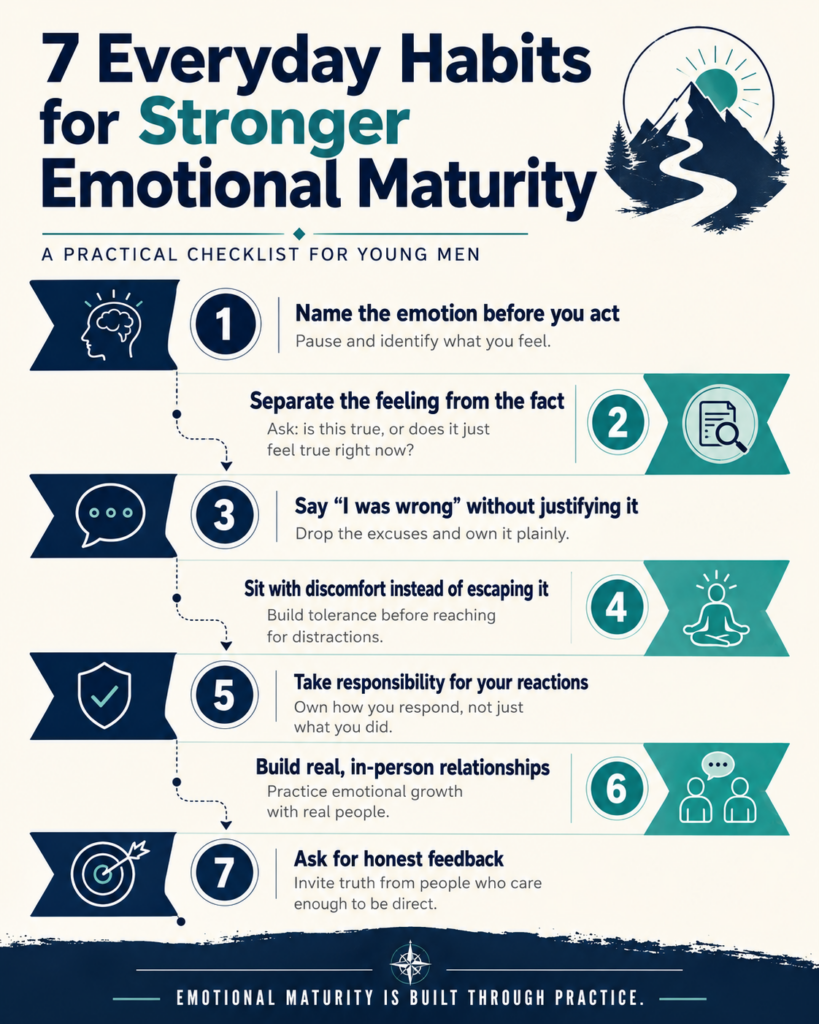
How to Become More Emotionally Mature: 7 Practical Steps
If you’ve been looking for something more concrete than “just grow up,” this section is built to give you that: specific, repeatable actions instead of vague advice.
Step 1: Name the Emotion Before You Act on It
If your first instinct is to snap back or go silent, that reaction makes sense; it’s automatic. The fix is inserting one deliberate step before it: name what you’re feeling, out loud or in your head (“I’m embarrassed,” “I’m scared I messed this up”). Naming an emotion activates the reasoning part of the brain and quiets the reactive part, a process researchers call “affect labeling.”
Step 2: Separate the Feeling from the Fact
If a strong emotion is making a situation feel bigger than it probably is, that’s a normal function of how emotions work; they’re not designed to be accurate, just fast. Ask yourself: “Is this actually a crisis, or does it just feel like one right now?” Write both answers down if you need to.
Step 3: Practice Saying “I Was Wrong” Without Justifying It
If admitting fault has always felt like losing, it’s worth knowing that’s a learned association, not a fixed rule. Say it plainly: “I was wrong about that.” No “but,” no explanation tacked on. This single habit does more for relationships and self-respect than almost anything else on this list.
Step 4: Sit With Discomfort Instead of Escaping It
If your go-to move under stress is a screen, a game, or a substance, that’s an understandable coping strategy. It works in the short term, which is exactly why it’s hard to drop. Build tolerance gradually: set a timer for 10 minutes where you sit with the uncomfortable feeling and do nothing to numb it. Increase the time weekly.
Step 5: Take Responsibility for Your Reactions, Not Just Your Actions
If you’ve noticed you can control what you do but still feel ambushed by how you feel, that gap is normal and closeable. Emotional maturity means owning your reactions too; recognizing “I overreacted” is as important as recognizing “I made a mistake.”
Step 6: Build Real, In-Person Relationships
If most of your social interaction happens through a screen, that’s increasingly common, and it’s also one of the biggest barriers to emotional growth, because regulation is practiced with real people, in real time, with real stakes. Prioritize face-to-face friendships, even if starting feels awkward.
Step 7: Get Feedback From People Who Aren’t Afraid to Be Honest
If you’ve surrounded yourself with people who only tell you what you want to hear, that’s comfortable, and it’s also why blind spots stay blind. Ask a parent, mentor, coach, or therapist directly: “Where do you see me struggling emotionally?” Then just listen.
Emotional Growth Quotes
If you find that a single sentence sometimes sticks with you longer than an entire article, that’s not a shortcut. It’s how memory and motivation actually work.
“The curious paradox is that when I accept myself just as I am, then I can change.” Quote by Carl Rogers, psychologist and founder of person-centered therapy.
“Vulnerability is not weakness; it’s our greatest measure of courage.” Quote by Brené Brown, researcher and author.
“In a very real sense we have two minds, one that thinks and one that feels.” Quote by Daniel Goleman, psychologist and author of Emotional Intelligence.
When Emotional Immaturity Needs More Than Self-Help

If you’ve tried the steps above and genuinely put in the effort, but nothing has moved, that’s not a sign the steps don’t work. It’s often a sign the pattern underneath needs more structure than a checklist can give.
For some young men, low emotional maturity isn’t just a habit problem. It’s tangled up with anxiety, avoidance, unresolved family dynamics, or a pattern sometimes called “failure to launch,” where a young man struggles to build the independence and coping skills expected of his age. Self-help articles, book recommendations, and even individual therapy sessions can only go so far when the environment around someone keeps reinforcing the same avoidance loop.
That’s the gap a structured program is built to close, combining:
- Individual therapy to identify root patterns
- Peer accountability with other young men in the same fight
- Daily real-world practice so growth isn’t theoretical
| If this sounds like where your son is right now, Forte Strong offers a free consultation to talk through what’s actually going on and whether structured support makes sense. |
FAQs
1. What is emotional maturity in simple terms?
Emotional maturity is the ability to feel your emotions fully without letting them control your decisions or behavior. It’s the difference between feeling anger and acting on anger without thinking.
2. At what age do men become emotionally mature?
There’s no fixed age. Emotional maturity depends on practice and environment, not just years lived. However, brain development related to impulse control and decision-making continues into the mid-to-late twenties, so full emotional maturity is rarely realistic much earlier than that, and some people continue developing it well beyond 30.
3. Can emotional maturity be learned, or is it a personality trait?
It can absolutely be learned. Emotional maturity is a set of skills, including self-awareness, regulation, responsibility, and communication, that improve with deliberate practice, similar to physical fitness.
4. What’s the difference between emotional maturity and emotional intelligence?
Emotional intelligence is understanding emotions in yourself and others. Emotional maturity is what you do with that understanding, specifically, whether you act on it in a healthy, responsible way under real pressure.
5. How can I tell if I lack emotional maturity?
Common indicators include reacting defensively to feedback, avoiding difficult conversations, blaming others for problems you played a role in, and relying on distraction instead of processing hard emotions. Recognizing these patterns is itself a sign of growing self-awareness.
What should a parent do if their adult son seems emotionally stuck?
Start with an honest, non-confrontational conversation, and consider outside support if home-based efforts haven’t worked. If this sounds like where your son is right now, Forte Strong offers a free consultation to talk through what’s actually going on and whether structured support makes sense.
Emotional Maturity Checklist
A simple, printable self-audit young men can use weekly to track real progress:
took responsibility for a reaction, not just an action
I named at least one emotion out loud or in writing today
I paused before reacting to something frustrating this week
I admitted being wrong at least once, without over-explaining
I had one real, in-person conversation instead of avoiding it
I sat with an uncomfortable feeling for at least 10 minutes without numbing out
I asked someone for honest feedback about my behavior